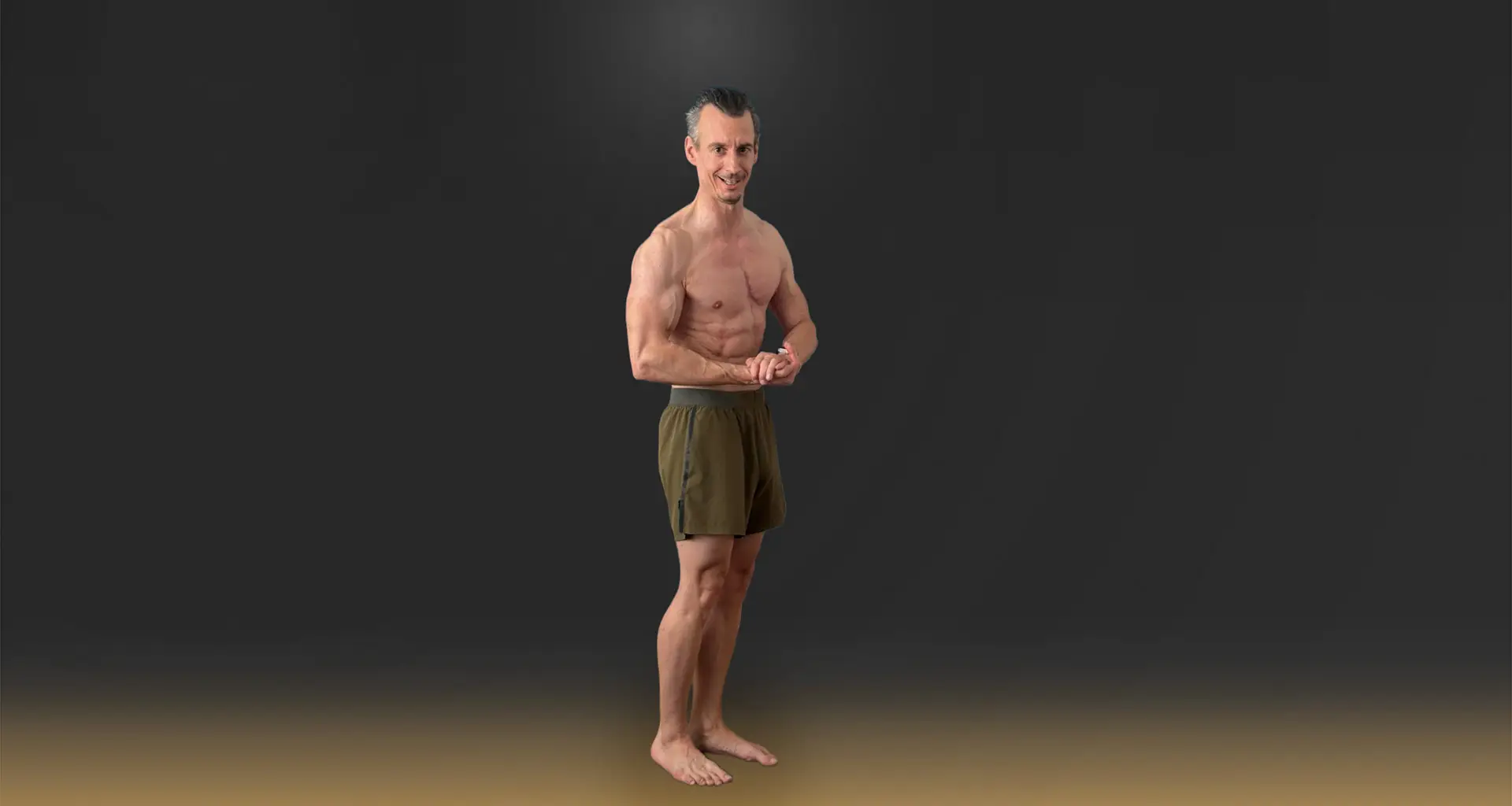
Muscle Damage and RBE (Repeated Bout Effect)
DOMS ≠ growth. Tension drives hypertrophy – damage is a by-product. The RBE dampens damage with repeated similar training and opens the door for real progression.
This page provides context and reference values. Not medical or individual training advice. Suitability and tolerability must be assessed individually.
What muscle damage is – and what it isn't
Muscle damage covers microtrauma and measurable markers such as DOMS and elevated creatine kinase. It arises mainly from novel stimuli, eccentric-heavy work and lengthened positions under load.
RBE – Repeated Bout Effect: after just one or a few similar sessions, damage and soreness drop noticeably at the same workload. The body adapts fast.
- Tension has priority: Mechanical tension is the primary driver of hypertrophy. Damage is a by-product – not a target.
- RBE in practice: Repeated, consistent execution → less microtrauma, more stable performance, better training continuity.
- Hardgainer context: Progress = stimulus × recovery (SRA). Unnecessary damage extends recovery with zero added benefit.
DOMS primarily signals novelty and load – not a reliable growth indicator. Performance trends, technique quality and strength gains carry far more weight.
Markers and common misconceptions
- Markers: DOMS, tenderness, stiffness, sometimes elevated CK/LDH. They correlate weakly with hypertrophy – not strongly.
- "More soreness equals more growth." Wrong. Severe soreness can actively sabotage training – movement quality drops, training frequency drops, recovery costs more.
- "New exercise equals better stimulus." Novelty increases damage. Variation is a tool – deploy it deliberately, not as a constant principle.
With complaints, injuries or pre-existing conditions: obtain medical clearance before changing training, sleep or nutrition.
Relevant deep-dive: Myth #8 – "No soreness, no muscle growth".
Repeated Bout Effect – what's happening?
- Rapid adaptation: After just 1–2 similar sessions, DOMS and damage markers drop noticeably – at the same volume.
- Protective mechanisms: Improved technique and coordination, altered muscle recruitment, structural adaptations such as more stable Z-discs.
- Practical consequence: The same volume starts to feel "easier". Use that for qualitative progression – not pointless volume explosions.
Programming guidelines
- Tension and technique first: Clean execution, full ROM, controlled eccentrics. Manage proximity to failure via RIR/RPE.
- Scale volume carefully: Start close to MEV, increase in small steps – only when performance and recovery stay stable. Respect MRV.
- Dose novelty: Exercise swaps and tempo variations sparingly. The bulk of the work runs in stable setups with a reproducible strength curve.
- Lengthened positions – applied smartly: Stretched positions under load work – start conservatively on sets and reps, then progress gradually.
- Frequency and SRA: Distribute hard work so target muscles can honour their SRA windows. Avoid overlapping heavy eccentric days.
Practice – 14-day orientation
- Week 1: Introduce a new exercise or phase with conservative volume and intensity. Focus on technique and range of motion.
- Week 2: Leverage the RBE – with technique stable, nudge load or reps slightly upward. No chasing soreness.
- Monitoring: Track morning weight, performance (top set/reps), subjective fatigue and movement quality.
Add metabolic work in measured doses – only after core sets built on solid tension quality.
FAQ
Is muscle soreness a sign of effective training?
No. DOMS correlates weakly with hypertrophy and primarily indicates novelty or unaccustomed load. Severe soreness can actively undermine training – movement quality drops, frequency drops. What matters: performance trends, technique quality and strength gains.
What is the Repeated Bout Effect and what does it mean for training?
The RBE describes how muscle damage and soreness decrease noticeably after just 1–2 similar sessions – even when volume stays the same. Improved coordination, altered recruitment and structural adaptations protect the tissue. In practice: consistent, repeatable training creates better conditions for qualitative progression than constant exercise variation.
What actually drives muscle growth if not soreness?
Mechanical tension close to failure is the primary driver. Muscle damage is a by-product, not a goal. Sound technique, full ROM, controlled eccentrics and intensity managed via RIR/RPE within the SRA window deliver the necessary stimulus – without unnecessary recovery costs.
That wasn't just reading. That was commitment.
If you want progress, you need a system. Get the Hardgainer Mission Briefing™ and execute one thing cleanly every week.
By signing up you will receive the download link for Hardgainer Hacks™ (PDF) and the Hardgainer Mission Briefing™ by email. You can unsubscribe at any time. Privacy Policy.
Further reading and resources
Directly on topic
- Hypertrophy · Mechanical Tension · Metabolic Stress
- RIR · RPE · SRA
- MEV · MRV
Descriptive information only – not a therapy, dietary or training prescription. Individual differences and possible contraindications must be considered.