Myth #10: “Supplements don’t work: it’s all placebo.”
By Christian Schönbauer · Training since 1999 · Start weight under 50 kg · Peak +25 kg · Mag. · Founder, Hardgainer Performance Nutrition®
Updated: March 2026. Content expanded.
Do supplements do anything or is it all placebo? For hard gainers, evidence beats marketing. Facts over feelings: Not all products are equal. Creatine, protein and caffeine have strong evidence. Well-designed blends (open formula, real doses, sensible combos) can leverage synergy effects, tailored to hardgainer needs.
This page provides context and guardrails, not individual medical, nutrition, or training advice. Suitability and tolerance are individual; for pre-existing conditions, pregnancy, or medication, consult qualified professionals before making changes. Study links lead to PubMed.
The Myth
“Supplements don’t work, it’s all placebo.”
False, but nuanced. There are highly effective basics, solid situational options and overpriced hype. If you dose evidence-based products correctly and nail training, nutrition and sleep, you benefit measurably.
Why the Myth Persists
Hype and disappointment: Wrong expectations plus poor products leads to “doesn’t work”. The problem is usually the product or the application, not the concept of supplementation.
Dose and timing errors: Underdosed or rarely taken produces no visible effect. Many supplements require consistency over weeks (e.g., creatine saturation) or precise timing (e.g., caffeine 30 to 45 min pre-workout).
Priorities flipped: Gaps in protein and calories, missing programme and lack of SRA respect, no supplement compensates for that.
Reality: Used correctly, supplements amplify processes already in motion. MPS, performance, recovery. Synergies can shift outcomes, but only with real doses and a clear goal.
The Facts: Evidence Classes at a Glance
Supplements are multipliers, not the base. Base = calories/protein, programme, SRA, sleep. Then the right products amplify what is already running.
Class A: Strong Evidence
Creatine monohydrate (strength and fat-free mass), protein to support MPS (hit the leucine threshold per meal), caffeine (performance, RPE↓).
Class B: Situation-Dependent
Beta-alanine (0.5 to 10 min efforts), sodium bicarbonate (≈30 s to 12 min high-intensity), nitrate/beetroot (blood flow, work capacity), electrolytes for heavy sweat loss, omega-3 (general recovery).
Class C: Context/Hype
“Miracles” without appropriate dose, form or quality, benefit usually marginal. Most marketing lives here; most substance does not.
| Supplement | Class | Primary benefit | Evidence dose |
|---|---|---|---|
| Creatine monohydrate | A | Strength, fat-free mass, energy | 3 to 5 g/day (no loading needed) |
| Protein (whey/casein) | A | MPS, leucine trigger, muscle retention | 1.8 to 2.2 g/kg/day distributed |
| Caffeine | A | Performance, RPE↓, focus | 2 to 3 mg/kg, 30 to 45 min pre |
| Beta-alanine | B | Endurance at 0.5 to 10 min efforts | 3.2 to 6.4 g/day split |
| Nitrate/beetroot | B | Blood flow, work capacity | ~300 to 500 mg nitrate/day |
| Electrolytes | B | Hydration, performance at high sweat loss | Situation-dependent |
Synergy & Entourage: Using Blends Strategically
Targeted combinations, e.g., energy system + blood flow + electrolytes, tackle multiple limiting factors at once. That can raise contextual effectiveness without replacing the basics.
Principle: Couple A-class + B-class smartly (e.g., creatine + caffeine + citrulline + electrolytes) → performance and training quality rise.
Blend quality checklist: Open formula (no proprietary blends), efficacious doses, standardised extracts, batch-tested, no sleep sabotage from late stim timing.
Evidence classes are guardrails, not dogma. B-class can be useful in the right setting; synergies can raise net effects, but only with real doses.
Mechanisms & Priorities
Order Wins
Train with RIR 1 to 2 and progression → MPS↑. Protein supplies substrate. Creatine boosts phosphoenergy. Caffeine lowers perceived exertion (RPE↓) and raises performance. The rest is fine-tuning, where blends can targeted-amplify.
Context Decides
A hardgainer under-eating calories and protein won’t grow from a pump booster. Fix calories cleanly (food hygiene), hit the leucine threshold per meal, use creatine and caffeine properly → performance and MPS rise → gains follow.
Total Energy in View
Supplements are part of the system: TDEE, TEF, NEAT and EAT define total energy expenditure. Anyone who doesn’t know their lean surplus doesn’t understand where supplements can help and where they cannot.
Practice: Hardgainer Stack by Priority
Level 1: Seal the Foundation
Programme first, RIR management, SRA respect, 1.8 to 2.2 g/kg protein and caloric surplus. Then supplements, never the other way around.
Level 2: Class-A Basics
Creatine monohydrate 3 to 5 g/day (timing secondary, consistency primary). Caffeine 2 to 3 mg/kg, 30 to 45 min pre-workout, cycle, respect sleep budget.
Level 3: Situational Additions
Beta-alanine (3.2 to 6.4 g/day split) for longer high-intensity efforts. Electrolytes for high sweat loss. Nitrate/beetroot in volume phases for improved work capacity.
Level 4: Targeted Blends
Only when goal, dose and quality align: couple Class A + B smartly (e.g., creatine + citrulline + electrolytes). No proprietary blends with pixel doses. Synergy is real, but only at genuine dosages.
Hardgainer Supplement Guide
The Hardgainer Supplement Guide cuts through the noise: which supplements actually move the needle for hardgainers, which ones are overrated, and why calories, protein, training and sleep must always come before the next powder.
Common Mistakes (and Better Alternatives)
| Mistake | Problem | Better |
|---|---|---|
| Supplements instead of basics | Cannot compensate for calorie/protein/programme deficits | Close the foundation first, then add supplements |
| Underdosing | Label claims ≠ efficacious dose | Use evidence doses; avoid proprietary blends |
| “Tried once, doesn’t work” | Some supplements need saturation/consistency | Evaluate consistently for 4 to 6 weeks (e.g., creatine) |
| Late stim timing | Caffeine too late → sleep sabotage → recovery suffers | Respect caffeine budget; stop at least 8 to 10 h before sleep |
Myth
“Supplements don’t work, it’s all placebo.”
FAQ
Do I need supplements to build muscle?
No, but the right ones can measurably improve performance, MPS and recovery. Anyone who masters the basics extracts noticeably more from the same training with Class-A supplements.
Do blends make sense?
Yes, if goal, dose and quality are right. Blends are amplifiers for specific limits (e.g., energy + blood flow + electrolytes), not a base replacement. Open formula and efficacious doses are non-negotiable.
Top 3 must-haves?
For most hardgainers: creatine monohydrate (3 to 5 g/day), protein (to hit the leucine threshold per meal), caffeine (dosed carefully, sleep respected).
When will I notice an effect?
Caffeine: immediately (30 to 60 min post-ingestion). Creatine: after saturation (days to weeks). Protein: over weeks via strength and body composition progress.
Is creatine safe?
Yes, creatine monohydrate is one of the most extensively researched supplements in existence. No established safety risks at standard dosages (3 to 5 g/day) in healthy individuals. Consult a physician for kidney conditions.
Why doesn’t creatine work for some people?
Creatine non-responders exist, their intramuscular creatine stores are already genetically elevated. This is rare. More commonly: creatine was taken too briefly (saturation not reached), underdosed, or the foundation (calories, training) was missing.
What the research says
Four papers behind the claims on this page
The evidence is consistent for the class A supplements. Creatine, protein and caffeine are among the best-documented performance and adaptation supplements there are.
- Safety and efficacy of creatine for strength and fat-free mass, comprehensive evidence review. Kreider et al., 2017 (ISSN Position Stand)
- Roughly 1.6 to 2.2 g/kg/day of protein optimises hypertrophy; the per-meal leucine signal counts. Morton et al., 2018 (BJSM meta-analysis)
- Caffeine improves muscle strength and power (upper body in particular); RPE tends to be lower. Grgic et al., 2018 (meta-analysis)
- Beta-alanine: benefit mainly in efforts lasting 0.5 to 10 minutes. Saunders et al., 2017 (systematic review and meta-analysis)
What is not covered by the studies
For most products outside this list the evidence is thin or absent. That does not mean they do not work. It means nobody knows. HGPN only carries what can be documented.
Practical takeaway: supplements are tools, not miracles. Use a few evidence-backed products correctly and master the basics, and you turn percentage points into measurable gains.
Conclusion
“Supplements don’t work, it’s all placebo.”, a myth that conflates two extremes: marketing hype and legitimate evidence.
A few evidence-strong products correctly dosed, supplemented where needed with targeted blends, on a stable base of training, nutrition and sleep, that is how percentage points become progressive, measurable gains.
Priorities first: supplements amplify what you do consistently. No supplement replaces calories, protein, training and sleep.
One clean step every week.
One clear mission per week in your inbox. No hype, no filler, plus new drops before anyone else.
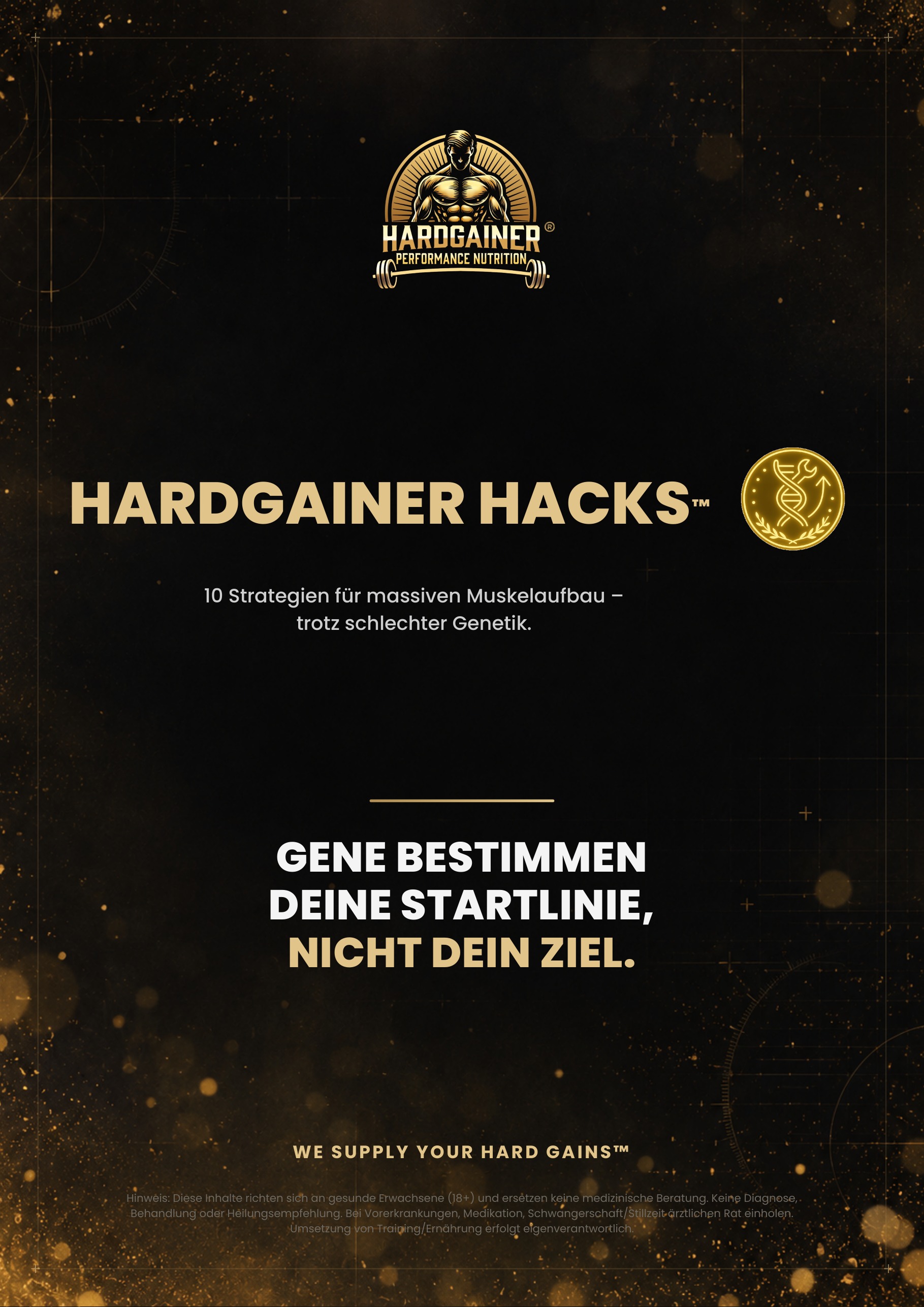 Hardgainer Hacks™ the moment you confirm. 10 strategies for real mass gain, straight to your inbox.
After signing up you get a confirmation email (double opt-in). Click it to confirm, otherwise nothing can be sent. Details on data processing in our Privacy Policy.
Further Reading & Resources
Supplements do not solve a base problem. They solve a specific one, if you have one.
Go deeper Hardgainer Supplements What is evidenced, what is optional and what you can skip. Open →Content is provided for general orientation and does not replace individual medical or training advice.