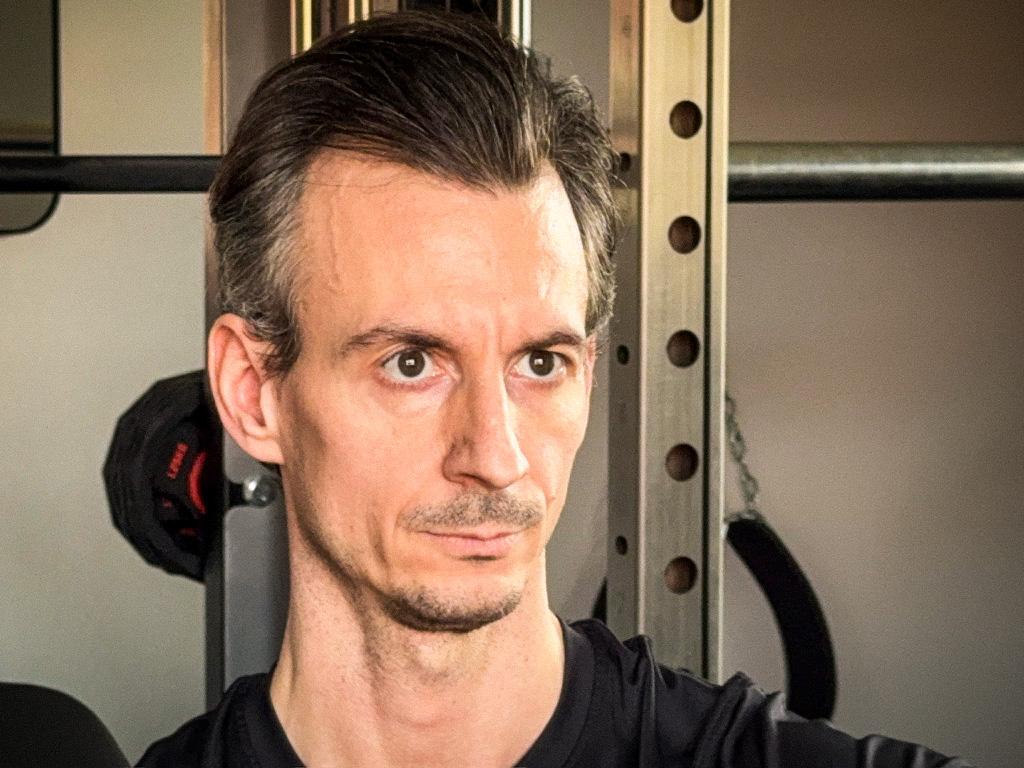
Ectomorph

By Christian Schönbauer · Training since 1999 · Start weight under 50 kg · Peak +25 kg · Mag. · Founder, Hardgainer Performance Nutrition®
Ectomorph is a body-type tendency: narrow frame, long levers, often lower fat mass. The label describes, but does not explain why someone struggles to gain weight. What matters are the measurable levers: BMR, NEAT, TDEE, Lean Surplus and Rate of Gain. For the hardgainer (hard gainer), these are the only levers that count.
Note
This page gives context and guardrails. It is not individual medical, nutrition or training advice. If you have a pre-existing condition or take medication, that question belongs with a qualified professional.
Ectomorph in 20 seconds
The term originates from William H. Sheldon's somatotype model of the 1940s. Sheldon classified three body types: ectomorph (slim, linear), mesomorph (muscular, athletic) and endomorph (broader frame, higher body fat). The ectomorph was characterised by a narrow skeleton, low fat mass, long extremities and a high ratio of body surface area to body mass.
In the context of strength training, the term is used descriptively today: a lean phenotype that may come with elevated energy expenditure and a subjectively difficult path to weight gain. As a planning framework for training or nutrition, it is unsuitable.
Related: Hardgainer, NEAT, TDEE, Metabolism.
In my early years I was so lean that my own family called me an "anatomical study", you could literally see every fibre on my body, simply because there was no fat over it. I first came across the word "ectomorph" when I started seriously reading about training. And for a long time I assumed it was the same as hardgainer, automatically, inevitably. But it isn't. Ectomorph describes how you look. Hardgainer describes what happens when energy balance and daily structure don't add up. That distinction matters.
Where it sits in the system
Sheldon's model is not scientifically validated as a predictor of training adaptations or muscle-building potential. The key criticisms:
- No causality: Somatotypes describe external features but explain no mechanisms such as myofibrillar proliferation or hormonal response to training.
- Plasticity: Body composition changes considerably through training and nutrition. An ectomorph who trains progressively and eats consistently will build muscle mass.
- Measurement problems: The classification relies on visual estimation, not reproducible measurements. Inter-rater reliability and stability over time are low.
- Spectrum, not classes: Most people sit between types. Three discrete categories are not biologically defensible.
The model has communicative value as everyday shorthand. As a basis for individual training or nutrition planning, it is not fit for purpose.
The numbers that matter
The somatotype model gives you not a single number you can work with. The classification comes from looking, not from measuring. What is measurable sits in the right-hand column.
| What the label claims | What you can actually measure |
|---|---|
| "narrow frame" | wrist circumference, elbow breadth, height |
| "low fat mass" | body fat percentage and fat-free mass |
| "high energy expenditure" | BMR, NEAT, TDEE |
| "gains with difficulty" | rate of gain across 14 days |
| "ectomorphic type" | nothing. There is no cut-off above which someone is an ectomorph. |
The one frame measure with numbers
If you want to quantify skeletal frame, wrist circumference is the common measure. Taken at the narrowest point, just below the wrist bone.
| Wrist circumference, men | Frame |
|---|---|
| under 17 cm | narrow |
| 17 to 19 cm | medium |
| over 19 cm | broad |
Common practice values from dietetics, not research findings. They describe the frame and say nothing about your growth potential.
Which is exactly the point: even the best frame measure does not explain why you are not gaining. A narrow wrist changes nothing about energy balance. The numbers that decide your build all sit in the right-hand column of the first table.
How to measure it
There is a method for determining somatotype. It is called Heath-Carter and uses skinfold thicknesses, bone breadths and circumferences. It ends in three numbers between 1 and 7, one per component.
And then what? Nothing. The value tells you how you look right now, not what to do. There is no training decision and no nutrition decision that follows from a somatotype rating. So the honest answer to how you measure your type is: you do not.
- Measure your maintenance instead. Ten to fourteen days of constant intake, 7-day average weight. That is the number that steers your build.
- Measure your steps. In lean, restless people NEAT often sits several hundred calories above average. That explains more than any body-type label.
- Measure circumferences every four weeks. Upper arm, chest, thigh, waist. That shows you whether the structure is changing, and structure does change.
Three measurements, two minutes a week. Together they tell you more about your build than any type classification ever has.
Ectomorph is not hardgainer
These terms are often used interchangeably. That is imprecise. The difference:
Morphological description: narrow bone structure, lean frame, long limbs. Refers to body structure, partly genetic, changeable through nutrition and training.
Functional profile: struggling to build weight and muscle despite training and the feeling of eating enough. Causes: elevated NEAT, underestimated maintenance calories, surplus too small.
The overlap is real, an ectomorphic build often carries characteristics that make weight gain harder. But a hardgainer need not be ectomorphic, and an ectomorph is not automatically a hardgainer. What determines progress is the actual energy balance, not the label.
More on the hardgainer definition: Glossary entry: Hardgainer
Typical characteristics of the build
- Narrow joints: Wrist and shoulder width tend to sit in the lower average range. Visible muscle volume appears smaller, even at identical muscle mass compared to broader builds.
- Long limbs: Altered leverage ratios in compound movements (squat, deadlift). With adjusted technique and full range of motion, longer levers become an advantage for the mechanical stimulus.
- Elevated NEAT: Many lean individuals show unconsciously higher daily activity, fidgeting, frequent standing, more movement. This meaningfully raises TDEE without being actively perceived.
- Low body fat: Visually advantageous, but practically it means the caloric surplus for muscle building must be set precisely, there is little buffer.
In practice: 14 days
Two weeks to replace the label with numbers. After that you stop talking about your type and start talking about your maintenance.
- Day 0: weight, four circumferences, one photo. Set the calorie target with the calculator, fix a step corridor.
- Day 1 to 14: weight every morning, steps every evening, training log with load, reps and RIR.
- Day 7: build the first weekly average, change nothing yet.
- Day 14: second weekly average. Rising by less than 0.25 per cent of body weight per week means the surplus was too small. Standing still means you were at maintenance, whatever it felt like.
After those fourteen days you know a number you previously guessed. In almost every case it is higher than expected, and that is not a question of type, it is a question of balance.
Six steps that actually count
- Establish maintenance: Track maintenance calories accurately first (10 to 14 day trend) before setting any surplus.
- Set a lean surplus: Start at +150 to 250 kcal above TDEE. NEAT swings of 300 to 500 kcal/day are realistic, factor in a small buffer.
- Hit protein targets: 1.6 to 2.2 g/kg body weight daily, distributed across 3 to 5 meals to regularly hit the leucine threshold for muscle protein synthesis.
- Volume in the effective range: Train between MEV and MRV, regulated with RIR/RPE. More volume at a caloric deficit is counterproductive.
- Respect SRA timing: Progress happens during recovery. SRA only completes fully when calories and sleep are aligned.
- Trend over daily noise: Monitor Rate of Gain via weekly averages, do not react to daily weight fluctuations.
Where it goes wrong
The most common patterns that block progress, and how to fix them:
- "I already eat a lot" without tracking: Caloric intake is systematically underestimated by 20 to 40 %. Without a logbook there is no reliable basis for adjustments.
- NEAT erases the surplus: More training often unconsciously raises daily activity too. If weight stagnates despite "eating more", check activity level first before blindly adding calories.
- Too much volume, too few calories: High training volume at a caloric deficit accelerates stagnation. Volume and caloric intake must be matched.
- Body type label as an excuse: "I'm just ectomorphic" blocks engagement with the actual levers. The label describes a tendency, it explains nothing and justifies nothing.
If no weight trend is visible after 14 days: stabilise the NEAT corridor first, then add +150 to 250 kcal. Then observe for another 10 to 14 days.
Common questions
Does being ectomorph mean a hardgainer is stuck with their genetics?
No. Genetics set the boundaries, but your outcome is determined by measurable variables: maintenance calories, lean surplus, training volume (MEV, MRV), progression and recovery timing within the SRA cycle. The label is a rough description, not a verdict.
Why does an ectomorph fail to gain weight despite eating a lot?
It is usually a combination of higher daily activity (NEAT), underestimated food intake and a surplus that is too small. The fix: establish maintenance calories accurately, then set a deliberate lean surplus and verify progress through rate-of-gain trend data.
Does more training help an ectomorph gain weight?
Not automatically. Without sufficient recovery, more training can mean less progress. What matters is staying within the effective volume range between MEV and MRV, combined with a controlled caloric surplus.
What is the difference between ectomorph and hardgainer?
Ectomorph is a phenotypic label from Sheldon's somatotype model, it describes structural tendencies but is not scientifically valid as a predictor of muscle-building potential. Hardgainer describes a functional situation: a structural energy gap driven by high NEAT, appetite suppression and an unstable surplus. You can be ectomorph without being a hardgainer, and vice versa.
What levers actually matter for an ectomorph?
Only measurable parameters: maintenance calories (TDEE), lean surplus with a clear rate of gain, training volume between MEV and MRV, effort control via RIR/RPE, and recovery within the SRA cycle. The body-type label itself changes none of these levers.
From term to practice: your tools
The label gives you no number. These two tools do, and they are exactly the two that decide your build.


"If you're an ectomorph, you can't build muscle."
False. Body type labels describe tendencies, not outcomes. Progress comes from the basics: effective volume in the right range, progressive performance, enough energy and protein, and recovery that matches your training stress.
Deep dive: Hardgainer Myth-Busting, Myth #4
What the research says
Four papers behind the claims on this page
The question behind this page is a question about a model: does the somatotype concept carry weight as a basis for training and nutrition decisions. Four papers on that.
- The relationship between body composition and somatotype exists, but it is loose. The type describes a tendency, it determines nothing. That is the difference between description and prediction. Slaughter and Lohman, Human Biology, 1976
- Somatotype-specific prediction equations have clear limits and generalise poorly. Deriving an individual prediction from a type overstretches the model. Wilmore, Medicine and Science in Sports and Exercise, 1984
- Heath-Carter somatotyping can be integrated with modern body composition analysis and then yields anthropometric measures. That shows what the model can do: describe. And what it cannot: turn a description into a training decision. Ryan-Stewart et al., PLOS ONE, 2020
- Under overfeeding a substantial share of the extra energy went into unconscious everyday movement. That is the actual explanation for lean people who eat and still do not gain. Not a body type, energy balance. Levine et al., Science, 1999
What the studies do not cover
None of these papers tested whether ectomorphic people respond differently to resistance training than anyone else. Those studies do not exist, which is exactly why the model cannot carry a training recommendation. The wrist values in the table above are practice values from dietetics, not measured thresholds.
Practical takeaway: The type describes how you look. Energy balance decides what happens. Only the second one can be measured and changed.
Ectomorph understood. Now the system behind it.
One clear mission per week in your inbox. No hype, no filler, plus new drops before anyone else.
 Hardgainer Hacks™ the moment you confirm. 10 strategies for real mass gain, straight to your inbox.
After signing up you get a confirmation email (double opt-in). Click it to confirm, otherwise nothing can be sent. Details on data processing in our Privacy Policy.
Reading & Resources
Ectomorph describes the build, not the behaviour of your metabolism. Here is the main topic this term belongs to, plus the terms around it.
Main topic Physiology for Hardgainers Metabolism, hormones and appetite. The pillar where a label turns into measurable quantities. To the main topicContent here is general practice guidance and does not replace individual medical or nutritional advice.