
Bottleneck Analysis: the five hardgainer types
You are not doing ten things wrong. Usually exactly one is holding you back. A hardgainer who cannot gain weight rarely has a motivation problem and almost always has a bottleneck: one area weak enough that everything behind it stalls. The Bottleneck Analysis sorts the common patterns into five hardgainer types. Every hard gainer recognises themselves in one of them first, and that is where the lever sits.
By Christian Schönbauer, MA · Training since 1999 · Starting weight under 50 kg · Peak +25 kg · Founder, Hardgainer Performance Nutrition® · Updated 13 August 2026 · Reading time 8–10 min
These numbers describe the method, not your body. The evidence-backed claims sit under What the research says.
The Bottleneck Analysis is practical guidance for training and nutrition, not a medical diagnosis. Unexplained weight loss, persistent exhaustion, a racing heart or a suspected underlying condition belongs with a doctor.
Why one bottleneck and not ten building sites
Muscle growth has five requirements that all have to be met at the same time: enough energy, an expenditure that does not consume it, a sufficient training stimulus, recovery in between, and repetition across weeks. If one is missing, improving the other four does not help.
That is why generic advice fails hardgainers so often. "Eat more" is right for The Empty Tank and wrong for The Burnt-Out. "Train harder" is right for The Understimulated and the fastest dead end for The Burnt-Out. Without a clear assessment, every recommendation is a coin flip.
- Intake. Counted across the week, does enough energy and protein actually land?
- Expenditure. How much do NEAT, daily life and cardio take back off the top?
- Training stimulus. Does the muscle get a reason to adapt?
- Recovery. Does your body get the time between sessions to convert the stimulus?
- Consistency. Does all of that repeat reliably, including in a bad week?
The Bottleneck Analysis measures all five areas and puts them in order. The highest value is your type. On a tie: recovery before intake, intake before stimulus. Working in the reverse order produces effort without result.
The five bottleneck types
Read through them. As a rule you will recognise yourself in one profile far more clearly than in the other four. That is already a useful first signal, but it does not replace the measurement in the test.
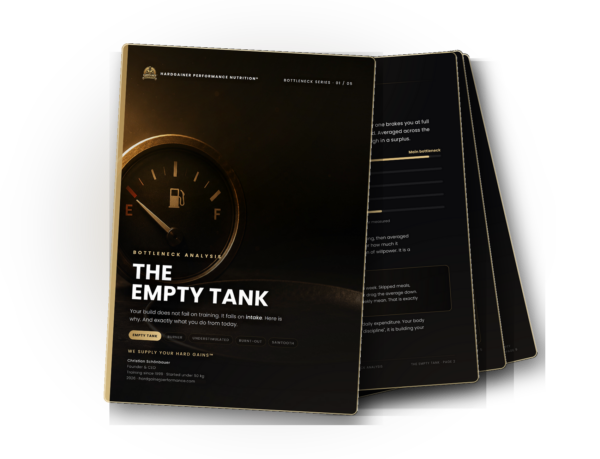
The Empty Tank
It feels like you eat a lot. Counted across the week you still never land in a surplus.
- Your weight has been flat or slightly down for weeks
- You don't track, or only on the good days
- Two or three days a week fall below your needs
- You feel full before the calories add up
The Empty Tank does not have a motivation problem, it has an arithmetic problem. The good days are good. The bad days pull the weekly average down far enough that maintenance replaces growth. Fullness is not a matter of willpower here, it is a physiological limit.
First lever: Know your real requirement first, then repair the weakest day of the week. Do not make the best day even better.

The Burner
You really do eat a lot. Your expenditure eats the surplus before it ever arrives.
- You are constantly moving, often without noticing
- A standing or walking job, a lot of distance on foot
- Additional sport on top of resistance training
- Eating more makes you restless rather than heavier
NEAT is the part of your expenditure that does not come from training: walking, standing, fidgeting, posture. That is exactly the part that responds to a surplus by ramping up. This is why the standard formula fails for you. Your requirement is not a fixed number, it is a moving target.
First lever: Set expenditure realistically instead of optimistically, and secure the surplus through calorie carriers that do not fill you up.
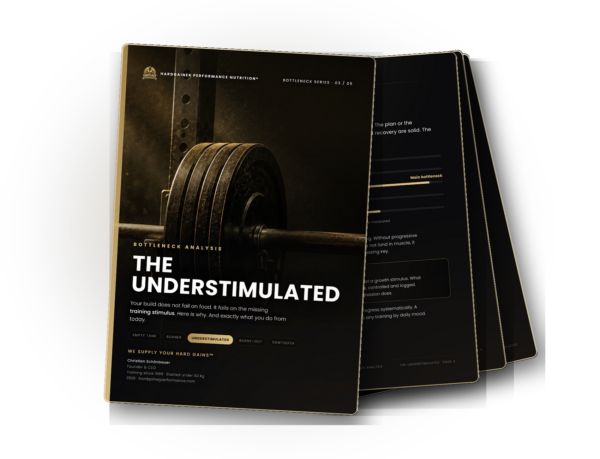
The Understimulated
Food and recovery are fine. Your muscle still gets no reason to grow.
- You have trained with the same loads for months
- No plan, or a plan without defined progression
- You stop well short of failure
- Volume and frequency swing from week to week
A stimulus has to increase repeatedly or the body stops adapting. Understimulated does not mean lazy. It means progression is not written down and therefore disappears in daily life. On top of that, the spread in training response between people is large, so a standard plan does not fit everyone.
First lever: Write progression down, in reps or in load, and manage proximity to failure deliberately.
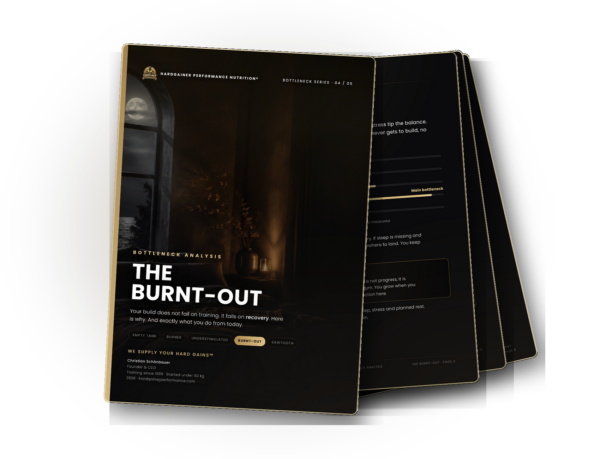
The Burnt-Out
You train hard and you eat enough. Your body still never gets to build.
- Under seven hours of sleep on most days
- Sustained tension, work pressure or exam periods
- Performance in the gym drops instead of rising
- Appetite and sleep quality swing a lot
Growth does not happen during training, it happens between sessions. Sleep restriction lowers myofibrillar protein synthesis measurably. Adding more stimulus in that state widens the gap between load and recovery instead of closing it.
First lever: Stabilise sleep and total load first, then raise the stimulus again. In that order, not in parallel.

The Sawtooth
Every single piece is right. They just don't mesh reliably.
- Two strong weeks, then two where nothing happens
- Your weight curve goes up and back down
- You restart often instead of continuing
- Under stress, food or training is the first thing to go
The Sawtooth does not lose knowledge, it loses to friction. Every decision you have to make fresh each day costs something. As soon as life presses, the lowest-effort option wins, and that is rarely the right one.
First lever: Define a minimum version that still works in a bad week, and measure progress instead of guessing it.
* Price incl. VAT. The rate depends on your country, the final amount is shown at checkout.
How to find your type
The Hardgainer Test asks nine questions about weight trend, eating behaviour, daily activity, training and sleep. At the end you get your profile across all five areas, your bottleneck score and your type. It takes under three minutes, costs nothing and does not ask for an email address.
Repeat the test after four weeks. That is how long a trend needs to become visible. Once you have worked on your bottleneck, the profile shifts and the next area moves to the front. That is how the model is meant to be used: as an order of operations, not as a label.
What is inside your Bottleneck Analysis
The test tells you which area is holding you back. The Bottleneck Analysis tells you what to do about it. It is a 13-page breakdown written for exactly one type, not for all five. That is why there are five of them and not one.
- Your mechanism. Why this specific area tips over in your pattern, and the physiology behind it.
- Your targets. Concrete numbers for energy, protein, training volume or sleep, depending on your type.
- Your protocol in seven steps. The order of execution, so you are not turning three dials at once.
- Your second lever. What to address once the first bottleneck is cleared.
- Your first 5-day mission. An entry point small enough that you will not postpone it.
Instant download after purchase, one-time payment, no subscription. The Bottleneck Analysis is not part of Hardgainer Pro. Pro unlocks the Pro versions of the tools, the Analysis is the written deep dive for your type. They complement each other and each works on its own.
Per analysis 19,90 €* · one-time · no subscription · instant PDF download
* Price incl. VAT. The rate depends on your country, the final amount is shown at checkout.
What the research says
Four papers behind the claims on this page. They cover the mechanism behind four of the five types.
- Sleep restriction lowers muscle protein synthesis measurably. One week of restricted sleep pushed myofibrillar protein synthesis down from 1.53 to 1.24 percent per day. This is exactly why recovery comes before any added training stimulus for The Burnt-Out. Saner et al., The Journal of Physiology, 2020
- Expenditure responds to a surplus and partly consumes it. With a 1000 kcal surplus over eight weeks, the change in NEAT explained a tenfold difference in fat storage between participants. That is the basis of The Burner profile. Levine, Eberhardt, Jensen, Science, 1999
- Protein has a clear breakpoint, beyond it more does nothing. The meta-analysis across 49 studies and 1863 participants places it at roughly 1.62 g per kilogram of body weight per day. For The Empty Tank the lever is total energy, not more protein. Morton et al., British Journal of Sports Medicine, 2018
- People respond very differently to the same training stimulus. After an identical programme the range of gains reached from practically zero to large. For The Understimulated the problem is therefore not the plan itself, but the missing adjustment to your own response. Variability in muscle size and strength gain after unilateral resistance training
What is not covered by studies
There is no solid evidence for The Sawtooth, because consistency in everyday life is hard to measure cleanly. The recommendations there come from practice, not from the literature, and are marked as such. Sorting people into five types is a working model for setting priorities, not a validated classification.
One clean step every week.
One clear mission per week in your inbox. No hype, no filler, plus new drops before anyone else.
 Hardgainer Hacks™ the moment you confirm. 10 strategies for real mass gain, straight to your inbox.
After signing up you get a confirmation email (double opt-in). Click it to confirm, otherwise nothing can be sent. Details on data processing in our Privacy Policy.
Frequently asked questions
What is the Bottleneck Analysis?
The Bottleneck Analysis sorts your muscle building into five areas: intake, expenditure, training stimulus, recovery and consistency. The area with the highest score is your bottleneck. The Hardgainer Test makes that call in nine questions, and the result is one of the five hardgainer types.
Can I have more than one bottleneck at a time?
Yes, and that is the normal case. This is why the test shows all five values as a profile instead of a single label. What matters is the order: the strongest bottleneck gets worked on first, because everything behind it stays stuck. On a tie, recovery comes before intake, and intake before stimulus.
Is the Bottleneck Analysis part of Hardgainer Pro?
No. Hardgainer Pro unlocks the Pro versions of the tools, meaning the calorie calculator, the MealPlan Generator and the workout plan generator. The Bottleneck Analysis is a separate product written for your type and is bought on its own.
How often should I retake the test?
Every four weeks. That is how long a trend in weight and performance needs to become visible. Once you have worked on your bottleneck, the profile shifts and the next area moves to the front. The test reminds you automatically.
Does this replace advice or a diagnosis?
No. The Bottleneck Analysis is practical guidance for training and nutrition, not a medical diagnosis. Unexplained weight loss, persistent exhaustion or a suspected underlying condition belongs with a doctor.
Further reading & resources
Once you know your type, the matching tools and the pillar behind it are here.
Start · Self-test The Hardgainer Test Nine questions, a profile across all five areas, your bottleneck type at the end. Free and no email required. Take the test →Content is general practical guidance and does not replace individual medical or nutritional advice.